



AI BUSINESS SOLUTIONS FOR SMALL BUSINESSES
A Beginner’s Guide to AI Growth and Automation
AI is transforming the world and changing how we work, learn, create, and interact with technology and businesses. The rise of AI brings many possibilities. However, it also raises important questions and concerns. We need to have careful and detailed discussions about these issues.
Written By: Zach Huffman
Read Time: 20 Minutes
The AI Opportunity For Business
What once was considered a Sci-fi dream or reserved for the giant Fortune 500 companies has now made its way down Main Street. Some early reporting indicates that AI tools already handle billions of daily searches. These numbers emerging at such an early stage of the technology's lifecycle offer undeniable proof: artificial intelligence isn't a passing trend; it's a permanent fixture in our daily lives.
While consumers find the AI use case undeniable, it is becoming an essential piece of the small business toolkit, empowering them to save time, cut costs, and compete in the digital-first era. Whether you're a roofing contractor, plumber, retail store, or solopreneur juggling 15 tasks simultaneously, AI can help you do more with less.
We built this guide for small business owners with zero technical background who want to understand today's changes. We will discuss AI business solutions and AI marketing and provide a comprehensive AI knowledge base with limited jargon, little hype, and just real-world applications and easy wins to help you grow.
Table of Contents
📘Before Reading download our Common AI Terminology PDF
What is AI (Artifical Intelligence)?
AI, in simple terms, is software that mimics the human intelligence process to complete tasks that previously required human involvement, such as learning, reasoning, problem-solving, and decision-making. While we can explain AI in simple terms, it's essential to recognize that the technology is far from simple.
It can learn patterns from data without being explicitly programmed. It features layers of deep learning algorithms inspired by the human brain to connect the dots and comprehend information. It can also understand, interpret, and generate human language while adapting to different contexts in real-time.
The best part? Most AI systems improve over time by ingesting more information, adjusting based on user behavior, and updating on the fly. Traditionally, most software requires complete code rewrites anytime you want to change the outcomes.
The 3 Types Of AI You May Hear About
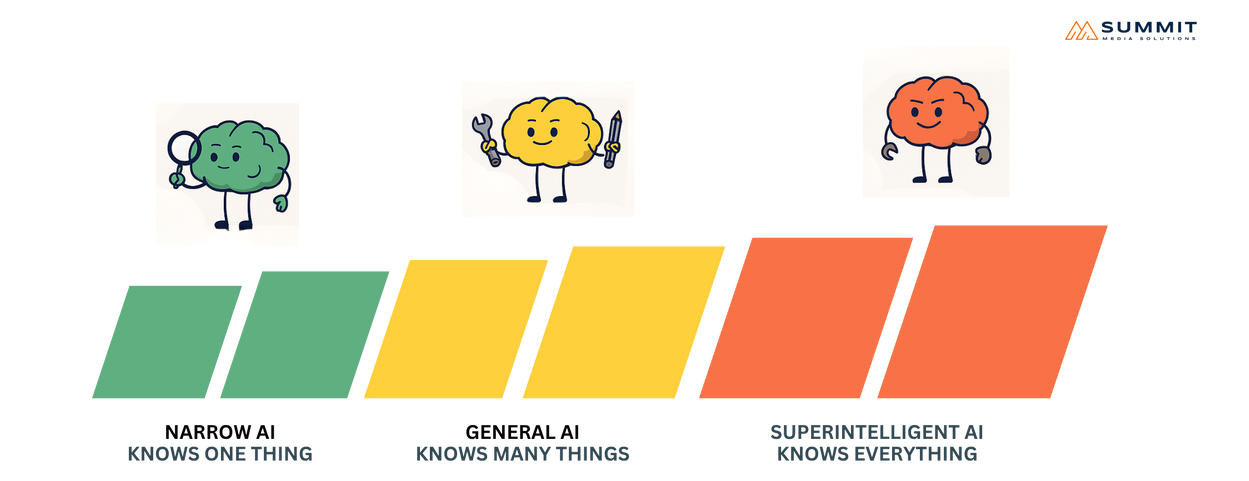
When most people first hear "AI," their minds jump straight to sci-fi — robots, world domination, and a full-blown Terminator scenario. While those dystopian visions make for good entertainment (and aren't entirely outside the realm of possibility), staying grounded is essential. To truly understand where we are and where we're headed, we need to break down the three core types of AI that are most often referenced in real-world conversations.
We are Here
Narrow AI
Narrow AI is an AI system designed to perform specific (narrow) tasks or solve problems within a particular scope. AI tools classified as narrow cannot think or perform tasks outside of the predefined parameters. Some examples are Alexa, Siri, and Netflix recommendation algorithms. Even ChatGPT, despite its wide range of capabilities, is still considered Narrow AI because it operates based on patterns in data rather than true understanding or independent reasoning.
While these systems are extremely powerful, they pale compared to General AI's and Superintelligent AI's theoretical models.
Theory
General AI
General AI, also known as Artificial General Intelligence (AGI), refers to machines that can reason, learn, and apply knowledge across a wide range of tasks, much like humans. Unlike Narrow AI, which is limited to specific functions, AGI would be capable of transferring knowledge from one domain to another and adapting to new situations without human intervention. In essence, it represents an AI system that can perform any intellectual task a human being can.
Theory
Superintelligent Ai
Superintelligent AI, often called Artificial Superintelligence (ASI), is a theoretical concept representing the next leap beyond General AI. While AGI would match human intelligence, ASI would surpass it. It is so advanced that it exceeds human intelligence, being able to think, innovate, and reason at a level humans literally can't comprehend. It would match human performance and outperform us in science, creativity, strategy, and emotional intelligence.
So why does this matter? In today's media landscape, AI is often framed through a lens of worst-case scenarios and dystopian fear. While responsible discussions around risk are vital, the noise is drowning out business opportunities today. AGI & ASI could be here tomorrow or never so understanding the different types of AI will help you cut through the hype, calm the hysteria and begin unlocking the real, practical benefits AI has to offer.
The 3 CORE AI Technologies
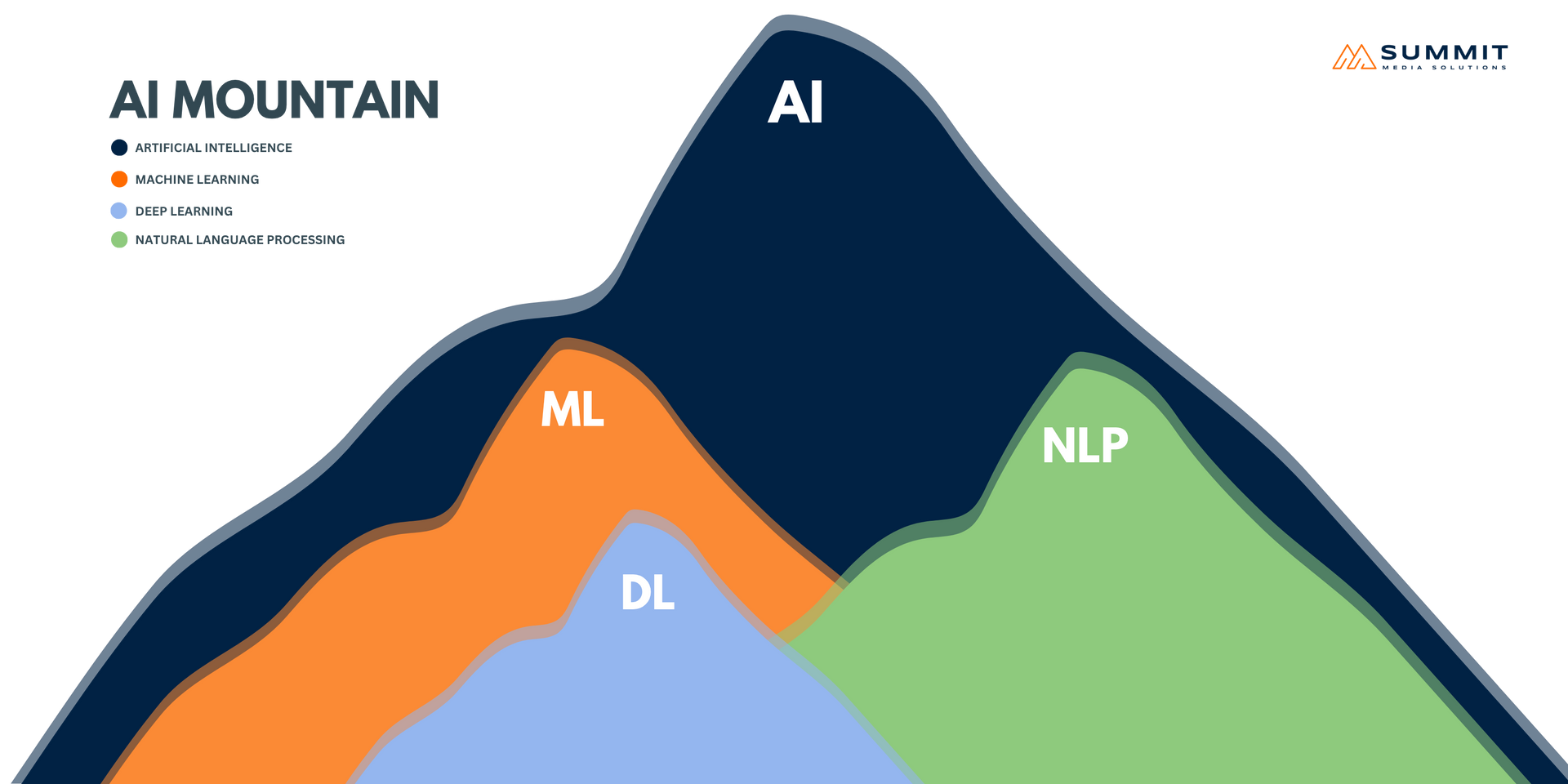
Three core technologies power most AI systems: Machine Learning, Deep Learning, and Natural Language Processing. These technologies are often used individually or in combination to build AI tools and applications. Let's break each one down with a brief overview to help you understand how they contribute to AI.
Machine Learning (ML)
Machine Learning (ML) is an AI that lets systems learn by looking at data rather than relying on someone to write out every rule. Instead of being told exactly what to do in every situation, ML figures things out by spotting patterns and making predictions based on what it's seen before. This is a big shift from old-school, rule-based systems that needed strict instructions for every outcome. With ML, the system learns through examples.
For example, to teach a system to differentiate cats and dogs, you wouldn't need to hard-code traits like "cats have pointy ears" or "dogs bark." Instead, you'd upload labeled images of both animals. The machine learning model would study the visual patterns and learn to distinguish them independently, even if you never told it what an ear or a bark is.
Deep Learning (DL)
Deep learning is a subset of Machine Learning, with one key distinction: traditional Machine Learning often requires human involvement to decide which essential features or data points. On the other hand, Deep Learning uses structures called Artificial Neural Networks — modeled loosely after the human brain — to learn which patterns matter without manual input automatically. With Deep Learning, you can feed raw, unstructured data — like images, audio, or text — and the system will extract the necessary information independently.
Natural Language Processing (NLP)
Natural Language Processing teaches computers to understand and talk with people. The computer reads or hears your words, figures out what you mean, and then answers you or does what you asked for. The technology powers things like asking Alexa, "What's the weather?"
How AI Works: A Simplified Look
AI is far from a simple technology, but a 30,000-foot view of AI can be an impactful way to begin understanding what's actually happening when you engage these AI tools and software.
The Big Picture
When you use AI for the first time, you're likely to feel excitement, curiosity, and even a little intimidation. But along with those emotions comes a powerful realization.
AI doesn't think.
It may feel intelligent because it answers fast, uses big words, and sometimes sounds smarter than most people on a good day. Still, under the hood, AI is simply finding patterns in data and using those patterns to make predictions or decisions.
Most of today's AI is powered by a neural network, which is designed to loosely mimic the human brain's structure. You can think of it as a digital brain that learns by being shown tons of examples—and by "tons," we mean millions, sometimes billions. Once it sees enough examples, it starts understanding how things work and connecting the dots. It then uses that knowledge to generate responses or solve problems.
It's not magic; it's math, data, and much training.
The 3 Layers of a Neural Network
🟢 Input Layer:
The input layer is where AI receives the data. It could be a sentence, an image, or even a spreadsheet full of numbers.
Example: If you upload an image of a cat, the input might be the individual pixel colors from that image.
🟡 Hidden Layers:
Hidden layers are where the real pattern-finding happens. These layers start analyzing the input by passing it through multiple stages, with each layer building on the previous one's findings.
Example: One layer might detect the edges of objects, the next could identify shapes like ears or whiskers, and the next layer starts to recognize that all these features add up to a cat.
🔴 Output Layer:
The output layer gives the AI the final answer or prediction based on everything it learned from the hidden layers.
Example: The system concludes: "This is a cat."
Why This Matters
This is the foundation behind tools like Google Gemini, self-driving cars, chatbots, and tons of other AI tools. This brief and oversimplified explanation of AI will help you make smarter decisions about using, trusting, and leveraging AI in your personal and business life.

AI VS AUTOMATION: WHAT's THe DIFFERENCE
Things are moving quickly in the AI space, and at times, you'll hear terms like "AI" and "Automation," or perhaps even "AI Automation." Often, they are discussed simultaneously and used interchangeably, but they are truly different. Understanding the difference between the two can help your business make smarter decisions, avoid hype, and implement solutions that actually solve problems.
WHAT IS AUTOMATION?
Automation refers to using technology to perform tasks or processes without human intervention. It follows a predefined set of rules and instructions. Think of it like a digital assembly line; once set up, it repeats the same task over and over with speed and consistency.
Examples:
- Automatically send a welcome email when someone fills out a form.
- Generating invoices when an order is placed
- Scheduling social media posts in advance
Automation is great for repetitive, rules-based tasks. It doesn't think or adapt — it just follows instructions. But it's powerful because it saves time, reduces human error, and frees your team for more valuable work.
What is Artificial Intelligence (AI)?
AI is a branch of computer science focused on building systems capable of learning, reasoning, and adapting. These systems are built to simulate human intelligence, allowing them to learn from data and make predictions or decisions based on the patterns they recognize. They often improve over time with more input, much like how humans learn through experience.
Examples:
- Chatbots that understand and respond to customer questions
- Recommendation engines like Netflix or Amazon
- AI tools like ChatGPT that can write content, summarize emails, or answer complex questions
AI doesn't just follow instructions — it can figure out the best instruction based on what it learns. The more data it sees, the better it becomes at making predictions or generating outputs. That makes AI flexible, scalable, and incredibly powerful in the proper context.
WHy this Matters for Your Business?
Most businesses, especially small businesses, may not need to invest in full-blown AI. In fact, starting with automation is a great first step. Automating simple repetitive tasks like follow-ups, scheduling, and customer onboarding can save hours every week. Once you've nailed down the automation, layering AI on top can create some significant competitive advantages.
AI and automation aren't rivals; they're tools that work better together. Automation handles repetitive work, while AI handles smart work. The businesses that learn to blend both will win the next decade.
Unsure where to start? Our automation and AI specialists can guide you through identifying low-hanging fruit in your organization and create the snowball effect to position your business as a leader in your industry.
THE HISTORY & Evolution of AI*
*To showcase how powerful AI is this section "The History & Evolution of AI" was written solely by Open AI, ChatGPT4o. This section aims to provide you with insight and understanding of how advanced AI and Natural Language Processing is today.
To fully understand where artificial intelligence is headed, it helps to know where it came from. AI wasn't born overnight — it results from decades of research, breakthroughs, and persistence. Here's a quick walkthrough of some of the most pivotal moments that shaped the field of AI as we know it today.
1950s: The Spark of an Idea
In 1950, Alan Turing posed a controversial question at the time: Can machines think? This led to the creation of the Turing Test, a benchmark for whether a machine can convincingly imitate human intelligence. A few years later, at the Dartmouth workshop in 1956, the term "Artificial Intelligence" was officially coined. That event marked the birth of AI as a formal field of study, setting the stage for everything that followed.
1980s: Rise of the Expert Systems
After a period of slow progress, the 1980s brought renewed interest in AI with the rise of expert systems — rule-based programs that mimicked the decision-making abilities of human specialists. These systems were adopted in industries like medicine, engineering, and finance. Still, they could not learn or adapt beyond their programmed rules.
2012: Deep Learning Breaks Through
The AI field took a giant leap in 2012 when deep learning models outperformed all others in an image recognition competition known as ImageNet. This breakthrough showed that neural networks — especially deep learning architectures — could identify patterns in complex data far better than traditional methods. It sparked an AI renaissance.
2020s: From Research Labs to Real Life
We're now living through the mainstream explosion of AI. Tools like GPT-3 and GPT-4 (from OpenAI), Claude (Anthropic), Gemini (Google), and Mistral (Europe) have brought large language models into the public and enterprise spotlight. AI is no longer experimental — it's shaping how businesses communicate, create, and operate.
Visual creativity exploded, too, with image generation models like DALL•E, Midjourney, and Stable Diffusion pushing boundaries in design, advertising, and content creation. Interfaces like ChatGPT, GitHub Copilot, Google Bard, and countless others have made AI accessible — giving everyday users the power of natural language programming, instant summarization, and creative collaboration.
Milestone Technologies That Changed the Game
These technologies each represent a pivotal moment in AI's evolution:
- IBM Watson: Beat human champions on Jeopardy! and introduced AI-powered question-answering to the mainstream.
- AlphaGo: Created by DeepMind, it defeated the world champion in the ancient game of Go — a milestone once thought decades away.
- GPT-3 & GPT-4: Ushered in the era of large language models with near-human fluency in text generation.
- Claude, Gemini, Mistral: Competitors in the new wave of foundation models, each offering unique capabilities and training philosophies.
- DALL•E, Midjourney: Turned typed prompts into stunning visuals — redefining how we think about creative tools.
- ChatGPT, Copilot, Bard: Brought generative AI into everyday workflows — from writing and coding to customer service and brainstorming.
From Idea to Infrastructure
What started as a theoretical question in the 1950s has now become the modern world's infrastructure. AI is no longer a sci-fi subplot — it's embedded in the apps we use, the services we rely on, and the daily decisions businesses make. And this is just the beginning.
WHY Small Businesses Have The AI Upper Hand
When it comes to AI, most people assume big corporations with massive budgets will lead the charge. But in reality, small businesses are uniquely positioned to win — and win big.
Why? Because they're nimble. They can pivot faster, adopt new tools without endless red tape, and implement AI solutions where they'll move the needle.
While enterprise giants are still "strategizing," small businesses can already be executing—automating tasks, improving customer experience, cutting costs, and growing revenue with AI-powered precision. This is the moment when being small isn't a disadvantage—it's a superpower.
The AI playing field is wide open, and the early movers will define the future. The time to move is now, and as you read further, we hope to provide you with the knowledge and understanding to make educated decisions that impact today!
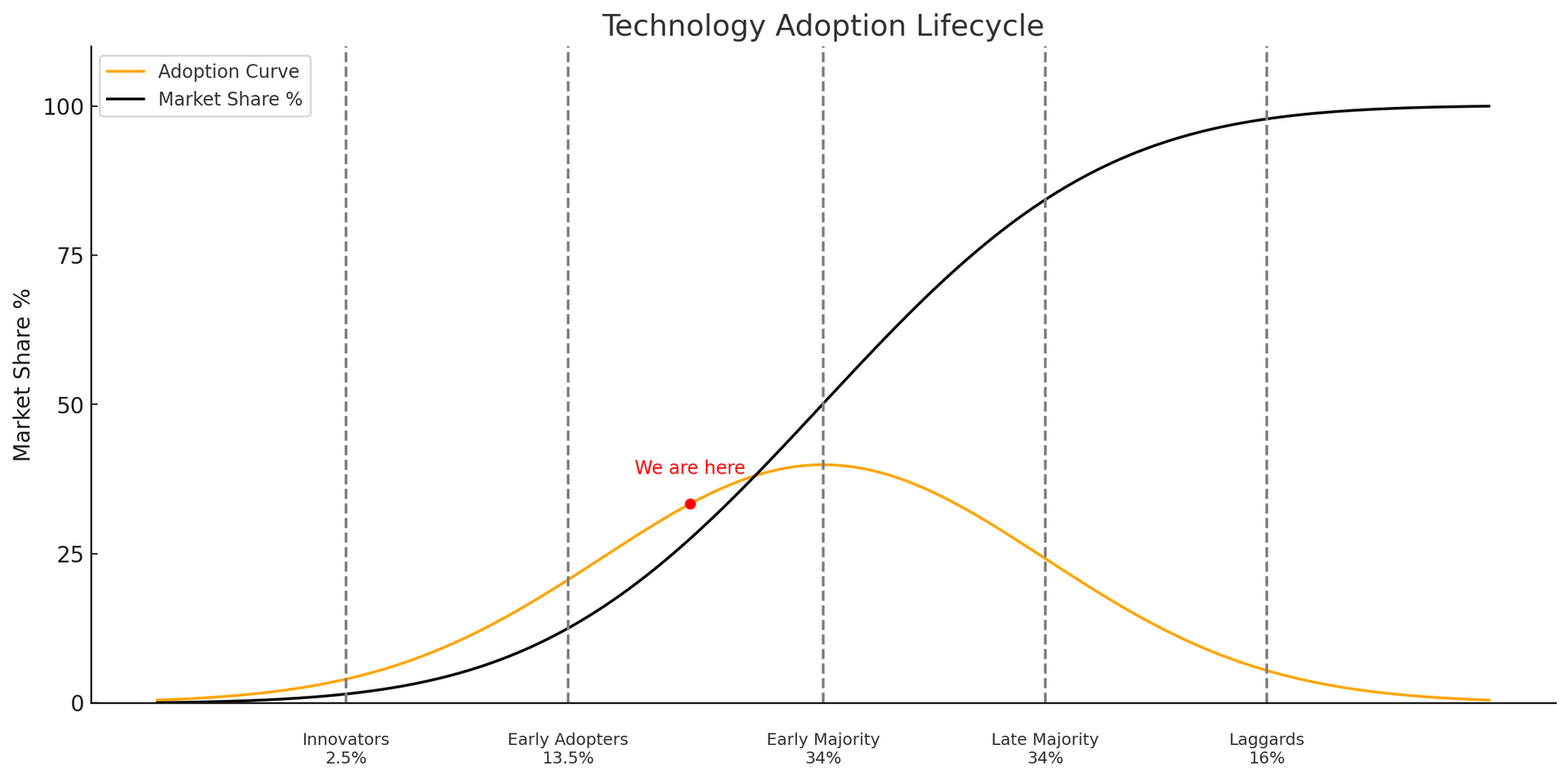
Inovators (2.5%)
Innovators are risk-tolerant visionaries eager to experiment with new technologies before they're proven. They are focused on trying new tools to understand how they can improve their work.
Early Adopters (13.5%)
Early adopters are opinion leaders who embrace emerging technology to gain competitive advantage and social capital.
Small Businesses are somewhere between Early adopters and early majority
Early Majority (34%)
The early majority adopt the technology once they see evidence of value and reliability, relying on references and use cases to justify the investment.
Late Majority (34%)
The late majority are skeptical and only adopt when a product is well-established, mainstream, and often driven by pressure or necessity.
LAGGARDS (16%)
Laggards resist change, adopting only when alternatives disappear or the cost of non-adoption outweighs their aversion to innovation.
Chat GPT has recorded the fastest adoption curves, crossing the 1 million user mark within weeks of its public release. People were quick to try it out every day because it was free, easy to use, and exciting. But most businesses have been slower to implement it, mainly because it requires more planning, training, and change. That means there's still a huge opportunity for companies willing to move early and advance.
The Top Business Benefits of AI
The benefits of AI in business can be grouped into four core categories: Efficiency, Scale, Accuracy, and Revenue. Within each of these are dozens of high-impact use cases that can deliver value with minimal effort. While a growing number of businesses are tapping into AI, the majority are still sitting on the sidelines. And that's a massive opportunity.
We see AI today the same way we saw the internet in the '90s: the early adopters didn't just benefit—they dominated. AI is no different. It's not a matter of whether it will disrupt industries; it's a matter of who will be doing the disrupting.
EFFICENCY
Do More WIth Less
AI helps you get more done in less time by automating the repetitive, time-wasting tasks that eat up your day. It’s like hiring an extra team member, without the overhead.
Automated Admin Tasks
Use AI to schedule meetings, send calendar invites, format emails, and manage your to-do list.
Inbox Management:
AI tools can categorize, prioritize, and even draft responses to emails automatically.
Customer Service Chatbots
Provide instant responses to common questions without needing a human agent.
Social Media Scheduling & Content Drafting
AI tools can create, caption, and auto-schedule your posts based on trends and engagement timing.
Document Generation
Contracts, proposals, blog outlines, newsletters — AI can handle first drafts in seconds.
Scale
Grow without The Headaches
AI lets you grow your business without growing your headcount. Whether it’s handling customer questions or following up with leads, AI works 24/7 so you can serve more people without burning out.
AI-Powered Lead Nurturing
Automatically follow up with cold leads, send drip campaigns, and qualify prospects via email or SMS.
24/7 Virtual Assistants:
AI chatbots or voice tools handle customer inquiries even when your team is offline.
Multilingual Support
Instantly translate messages or chats to serve global or bilingual audiences without hiring additional staff.
Automated Onboarding Flows
AI can guide new customers, employees, or vendors through onboarding steps via chat, email, or even voice.
ACCURACY
Make better decisions with less guesswork.
AI reduces human error and gives you better insights so you can make smarter, faster decisions. From forecasting sales to spotting customer trends, it removes the guesswork.
AI-Powered Analytics
Convert raw data into actionable insights about customer behavior, sales trends, and marketing performance.
Smart CRM Suggestions:
Get automated recommendations on which leads are hot, what follow-up to send, or who’s most likely to churn.
Inventory Forecasting
AI tools can help predict demand and reduce overstock/understock issues.
Sentiment Analysis
Use AI to scan reviews, emails, and social messages to detect customer satisfaction trends and common complaints.
REVENUE
Drive sales, upsell customers, and create new income streams.
AI isn’t just about saving time — it’s about making more money. AI helps you turn leads into customers and customers into repeat buyers.
AI Copywriting for Ads & Landing Pages
Generate sales-driven headlines, descriptions, and calls-to-action based on your goals.
AI-Driven Upsell Triggers
Suggest complementary products/services to customers based on their buying patterns.
AI-Generated Proposals
Automatically draft customized proposals for leads based on their industry, pain points, and goals.
Personalized Email Marketing
Send individualized campaigns at the perfect time with subject lines and offers tailored by AI.
Small businesses that embrace AI aren't just working smarter—they're building a competitive moat. The tools are available, and the use cases are proven. The only thing standing between your business and exponential growth is hesitation.
Don't wait for private equity or enterprise giants to make the first move and potentially disrupt your industry.
At Summit Media Solutions, we're passionate about helping small businesses grow and confidently guiding them through the evolving AI landscape. Our team of AI-focused experts is ready to help you identify high-impact opportunities, build a clear plan, and start your AI journey today.
What's Holding You Back from using AI FOR YOUR BUSINESS?
Uncertainty About How It Works
Many business owners feel overwhelmed by AI, unsure how it fits into their current processes or if it will deliver real value.
Fear of High Costs
AI solutions can be scalable, offering options that fit a range of budgets, ensuring businesses of all sizes can benefit without overspending.
Lack of Time
Running a business is time-consuming, and learning new technologies can seem like a hassle. Our AI tools are built to integrate seamlessly into your business operations.
These problems can make you feel overwhelmed, confused, and anxious about your business’s future. But you don’t have to tackle them alone.
Real-World Use Cases
AI has had a significant impact on businesses of all sizes and industries. From blue-collar trades to brick-and-mortar retail, AI is transforming how small businesses work, serve customers, and grow. Here are several real-world snapshots that show AI in action across industries:
PlumbING Company
The Problem
The company struggled with missed calls, delayed responses, and lost business after hours
The AI Solution
We implemented our AI Assistant (Chatbot) and Voice Receptionist called Inbox Pro, which was trained on the company's business details, website content, and standard operating procedures. It was designed to handle after-hours phone calls, answer common plumbing questions, and collect key service information to assist technicians ahead of each job, operating 24/7, 365 days a year.
Outcome
In just six months, the AI assistant captured and managed over 80 qualified leads, significantly reducing manual follow-up and scheduling delays. The business saw an increase in job completions and is now considering eliminating their after-hours answering service, saving them an estimated $30,000 annually.
Medical Equipment Provider
The Problem
The company was overwhelmed with phone calls and repetitive questions about complex medical equipment, taking up valuable time and slowing down its sales process.
The AI Solution
We deployed Inbox Pro, our intelligent AI Assistant that seamlessly integrates and is trained on the company's 300+ page website. It now handles FAQs in real time, delivering accurate product specs and detailed responses without human intervention.
Outcome
With Inbox Pro managing front-line inquiries, the team has reclaimed hours previously lost to low-level conversations. This shift allowed them to focus on serious buyers, resulting in 50+ qualified leads captured and a smoother path to conversion.
Family Entertainment
The Problem
Over time, the business accumulated hundreds of online reviews, causing its once-strong 4.8-star rating to dip to 4.2. This decline began negatively impacting both local search visibility and in-store foot traffic.
The AI Solution
We implemented Reputation 360, an AI-powered reputation management platform that uses sentiment analysis to surface trending keywords, review themes, and real-time customer satisfaction signals.
Outcome
Within hours, the AI identified exactly when and why the negative reviews began to spike. This allowed the business to make fast, data-driven decisions and take targeted action to fix the root issues. As a result, they've rebounded to a 4.6-star rating and now rely on Reputation 360 to monitor and manage customer sentiment and improve customer service.
Risks, Limitations & Misconceptions about AI
AI isn't magic, and it isn't perfect either. It is a tool that when understood and used correctly can have a massive impact on your business. While the positive impact is something we have talked a lot about thus far it isn't without risk or limitations. Some of the AI limitations and risks to consider are below.
AI Hallucinations
AI models like ChatGPT can generate factually incorrect or made-up information ("hallucinations"). Always review AI-generated content; it's a writing assistant, not a truth engine.
Risk of Over-Automation
Too much AI can make your business feel cold or robotic. Don't automate empathy. Use AI to handle repetitive work, then double down on the human touch.
AI Doesn’t Think Like Human
AI identifies patterns; it doesn't have beliefs, goals, emotions, or common sense. It processes input based on training data and delivers the most likely output.
How to start Using AI Today
Leveraging AI's benefits to streamline business processes, empower Support Teams, and make Informed Decisions that drive success isn't just a competitive edge — it's survival.
But let's be real: the most significant barrier between you and an AI-powered operation isn't technology. It's getting started.
That's why we've cut through the hype and built a crystal-clear roadmap—the exact process we give our partners who are just beginning their AI journey. There is no fluff, no guesswork, just a proven starting point that builds momentum fast.
If you're serious about future-proofing your business, this is where you begin.
If you've never used AI start here
See AI in Action
If you're new to AI, the first step is simple: try it out yourself. Go to one of the leading AI-powered tools, ChatGPT, Google Gemini, or Claude by Anthropic, and start a conversation.
Ask questions like:
- I'm new to AI; what should I know?
- What are three high-leverage ways I can use AI in my [role/business/industry] starting today?
- Please walk me through a step-by-step plan to solve [insert real-world problem or bottleneck].
There's no wrong way to start. The goal isn't perfection; it's to see how fast, flexible, and surprisingly helpful these tools can be.
Once you experience that firsthand, the rest of this 30-day roadmap will make 10x more sense.
Identify repetitive, low value tasks
Let's keep it simple. Grab a notepad or open up a blank doc — and write down all the parts of your job that feel like a drag.
These things slow you down, drain your energy, or keep you from doing the work that moves the business forward.
Maybe it's:
- Replying to emails
- Answering the same questions over and over
- Chasing people to book meetings
- Entering data into spreadsheets
- Pulling together reports
Now, take a step back and look at how your day flows.
- Where are the fire drills happening?
- What always feels disorganized?
- Where do things fall through the cracks or take way too long?
Once you've got your list, highlight a few easy wins — small tasks that feel annoying but would make a big difference if they run smoother. The goal here is not to fix everything overnight but to free up enough time to stack together some wins. If AI can help you save 5 min a day, that's over 30 hours a year, you could be focusing on anything and everything else.
Test The Workflow & Tools
Now that you have one key workflow to focus on, it's time to put your theory to the test. This week, you're putting the tools in play and walking the walk.
Reach out to us, and we can help you identify trusted AI tools to make your workflow dreams come true. If you are not ready to chat with us, that is okay. Here is a prompt you can copy/paste into AI to make tool recommendations.
Prompt
"I run a [type of business], and I want to automate and leverage AI to [describe your desired workflow]. Please help me build out this idea by providing me with tool recommendations and step-by-step implementation as if I am a beginner."
Using this prompt effectively will allow you to hit the ground running. Don't be afraid to ask the AI clarifying questions or perform follow-ups to make things easier. This is how our team is trained to use AI when working on AI automation and workflows.
Compound Efforts Across the Team
Once your new workflow is running smoothly, it's time to share it with the rest of your team. Oddly, everyone on your team can benefit from what you just built.
Think about it this way: if one person saves just 5 minutes a day, that adds up fast. Now multiply that across your entire team every day. That's real-time, real money, and real momentum.
This compounding efficiency is how modern businesses stay ahead, regardless of industry. Minor improvements, multiplied across the organization, lead to big results.

You Made It — Let’s Wrap This Up Right
First off, props to you. Most people talk about learning AI, and you followed through. This guide wasn't built to impress tech elites but to empower real-world operators and business owners who wear 10 hats and still manage to get the job done. Whether AI is the rise of the machines or just the best dang assistant you've ever had, one thing's clear: you now understand more about AI than 95% of small businesses out there.
Here's the bottom line:
The winners over the next 5 years won't be the biggest — they'll be the smartest. Smart means automated, AI-augmented, customer-obsessed, and ruthlessly efficient. If you want to speed up adoption, automate tasks, make sure your website is ready for AI Search and create an AI-first organization, our team is here to help you succeed.
AI BUSINESS SOLUTIONS FOR SMALL BUSINESSES
A Beginner’s Guide to AI Growth and Automation
AI is transforming the world and changing how we work, learn, create, and interact with technology and businesses. The rise of AI brings many possibilities. However, it also raises important questions and concerns. We need to have careful and detailed discussions about these issues.
Written By: Zach Huffman
Read Time: 20 Minutes
The AI Opportunity For Business
What once was considered a Sci-fi dream or reserved for the giant Fortune 500 companies has now made its way down Main Street. Some early reporting indicates that AI tools already handle billions of daily searches. These numbers emerging at such an early stage of the technology's lifecycle offer undeniable proof: artificial intelligence isn't a passing trend; it's a permanent fixture in our daily lives.
While consumers find the AI use case undeniable, it is becoming an essential piece of the small business toolkit, empowering them to save time, cut costs, and compete in the digital-first era. Whether you're a roofing contractor, plumber, retail store, or solopreneur juggling 15 tasks simultaneously, AI can help you do more with less.
We built this guide for small business owners with zero technical background who want to understand today's changes. We will discuss AI business solutions and AI marketing and provide a comprehensive AI knowledge base with limited jargon, little hype, and just real-world applications and easy wins to help you grow.
Table of Contents
📘Before Reading download our Common AI Terminology PDF
What is AI (Artifical Intelligence)?
AI, in simple terms, is software that mimics the human intelligence process to complete tasks that previously required human involvement, such as learning, reasoning, problem-solving, and decision-making. While we can explain AI in simple terms, it's essential to recognize that the technology is far from simple.
It can learn patterns from data without being explicitly programmed. It features layers of deep learning algorithms inspired by the human brain to connect the dots and comprehend information. It can also understand, interpret, and generate human language while adapting to different contexts in real-time.
The best part? Most AI systems improve over time by ingesting more information, adjusting based on user behavior, and updating on the fly. Traditionally, most software requires complete code rewrites anytime you want to change the outcomes.
The 3 Types Of AI You May Hear About
When most people first hear "AI," their minds jump straight to sci-fi — robots, world domination, and a full-blown Terminator scenario. While those dystopian visions make for good entertainment (and aren't entirely outside the realm of possibility), staying grounded is essential. To truly understand where we are and where we're headed, we need to break down the three core types of AI that are most often referenced in real-world conversations.
We are Here
Narrow AI
Narrow AI is an AI system designed to perform specific (narrow) tasks or solve problems within a particular scope. AI tools classified as narrow cannot think or perform tasks outside of the predefined parameters. Some examples are Alexa, Siri, and Netflix recommendation algorithms. Even ChatGPT, despite its wide range of capabilities, is still considered Narrow AI because it operates based on patterns in data rather than true understanding or independent reasoning.
While these systems are extremely powerful, they pale compared to General AI's and Superintelligent AI's theoretical models.
Theory
General AI
General AI, also known as Artificial General Intelligence (AGI), refers to machines that can reason, learn, and apply knowledge across a wide range of tasks, much like humans. Unlike Narrow AI, which is limited to specific functions, AGI would be capable of transferring knowledge from one domain to another and adapting to new situations without human intervention. In essence, it represents an AI system that can perform any intellectual task a human being can.
Theory
Superintelligent Ai
Superintelligent AI, often called Artificial Superintelligence (ASI), is a theoretical concept representing the next leap beyond General AI. While AGI would match human intelligence, ASI would surpass it. It is so advanced that it exceeds human intelligence, being able to think, innovate, and reason at a level humans literally can't comprehend. It would match human performance and outperform us in science, creativity, strategy, and emotional intelligence.
So why does this matter? In today's media landscape, AI is often framed through a lens of worst-case scenarios and dystopian fear. While responsible discussions around risk are vital, the noise is drowning out business opportunities today. AGI & ASI could be here tomorrow or never so understanding the different types of AI will help you cut through the hype, calm the hysteria and begin unlocking the real, practical benefits AI has to offer.
The 3 CORE AI Technologies
Three core technologies power most AI systems: Machine Learning, Deep Learning, and Natural Language Processing. These technologies are often used individually or in combination to build AI tools and applications. Let's break each one down with a brief overview to help you understand how they contribute to AI.
Machine Learning (ML)
Machine Learning (ML) is an AI that lets systems learn by looking at data rather than relying on someone to write out every rule. Instead of being told exactly what to do in every situation, ML figures things out by spotting patterns and making predictions based on what it's seen before. This is a big shift from old-school, rule-based systems that needed strict instructions for every outcome. With ML, the system learns through examples.
For example, to teach a system to differentiate cats and dogs, you wouldn't need to hard-code traits like "cats have pointy ears" or "dogs bark." Instead, you'd upload labeled images of both animals. The machine learning model would study the visual patterns and learn to distinguish them independently, even if you never told it what an ear or a bark is.
Deep Learning (DL)
Deep learning is a subset of Machine Learning, with one key distinction: traditional Machine Learning often requires human involvement to decide which essential features or data points. On the other hand, Deep Learning uses structures called Artificial Neural Networks — modeled loosely after the human brain — to learn which patterns matter without manual input automatically. With Deep Learning, you can feed raw, unstructured data — like images, audio, or text — and the system will extract the necessary information independently.
Natural Language Processing (NLP)
Natural Language Processing teaches computers to understand and talk with people. The computer reads or hears your words, figures out what you mean, and then answers you or does what you asked for. The technology powers things like asking Alexa, "What's the weather?"
How AI Works: A Simplified Look
AI is far from a simple technology, but a 30,000-foot view of AI can be an impactful way to begin understanding what's actually happening when you engage these AI tools and software.
The Big Picture
When you use AI for the first time, you're likely to feel excitement, curiosity, and even a little intimidation. But along with those emotions comes a powerful realization.
AI doesn't think.
It may feel intelligent because it answers fast, uses big words, and sometimes sounds smarter than most people on a good day. Still, under the hood, AI is simply finding patterns in data and using those patterns to make predictions or decisions.
Most of today's AI is powered by a neural network, which is designed to loosely mimic the human brain's structure. You can think of it as a digital brain that learns by being shown tons of examples—and by "tons," we mean millions, sometimes billions. Once it sees enough examples, it starts understanding how things work and connecting the dots. It then uses that knowledge to generate responses or solve problems.
It's not magic; it's math, data, and much training.
The 3 Layers of a Neural Network
🟢 Input Layer:
The input layer is where AI receives the data. It could be a sentence, an image, or even a spreadsheet full of numbers.
Example: If you upload an image of a cat, the input might be the individual pixel colors from that image.
🟡 Hidden Layers:
Hidden layers are where the real pattern-finding happens. These layers start analyzing the input by passing it through multiple stages, with each layer building on the previous one's findings.
Example: One layer might detect the edges of objects, the next could identify shapes like ears or whiskers, and the next layer starts to recognize that all these features add up to a cat.
🔴 Output Layer:
The output layer gives the AI the final answer or prediction based on everything it learned from the hidden layers.
Example: The system concludes: "This is a cat."
Why This Matters
This is the foundation behind tools like Google Gemini, self-driving cars, chatbots, and tons of other AI tools. This brief and oversimplified explanation of AI will help you make smarter decisions about using, trusting, and leveraging AI in your personal and business life.
AI VS AUTOMATION: WHAT's THe DIFFERENCE
Things are moving quickly in the AI space, and at times, you'll hear terms like "AI" and "Automation," or perhaps even "AI Automation." Often, they are discussed simultaneously and used interchangeably, but they are truly different. Understanding the difference between the two can help your business make smarter decisions, avoid hype, and implement solutions that actually solve problems.
WHAT IS AUTOMATION?
Automation refers to using technology to perform tasks or processes without human intervention. It follows a predefined set of rules and instructions. Think of it like a digital assembly line; once set up, it repeats the same task over and over with speed and consistency.
Examples:
- Automatically send a welcome email when someone fills out a form.
- Generating invoices when an order is placed
- Scheduling social media posts in advance
Automation is great for repetitive, rules-based tasks. It doesn't think or adapt — it just follows instructions. But it's powerful because it saves time, reduces human error, and frees your team for more valuable work.
What is Artificial Intelligence (AI)?
AI is a branch of computer science focused on building systems capable of learning, reasoning, and adapting. These systems are built to simulate human intelligence, allowing them to learn from data and make predictions or decisions based on the patterns they recognize. They often improve over time with more input, much like how humans learn through experience.
Examples:
- Chatbots that understand and respond to customer questions
- Recommendation engines like Netflix or Amazon
- AI tools like ChatGPT that can write content, summarize emails, or answer complex questions
AI doesn't just follow instructions — it can figure out the best instruction based on what it learns. The more data it sees, the better it becomes at making predictions or generating outputs. That makes AI flexible, scalable, and incredibly powerful in the proper context.
WHy this Matters for Your Business?
Most businesses, especially small businesses, may not need to invest in full-blown AI. In fact, starting with automation is a great first step. Automating simple repetitive tasks like follow-ups, scheduling, and customer onboarding can save hours every week. Once you've nailed down the automation, layering AI on top can create some significant competitive advantages.
AI and automation aren't rivals; they're tools that work better together. Automation handles repetitive work, while AI handles smart work. The businesses that learn to blend both will win the next decade.
Unsure where to start? Our automation and AI specialists can guide you through identifying low-hanging fruit in your organization and create the snowball effect to position your business as a leader in your industry.
THE HISTORY & Evolution of AI*
*To showcase how powerful AI is this section "The History & Evolution of AI" was written solely by Open AI, ChatGPT4o. This section aims to provide you with insight and understanding of how advanced AI and Natural Language Processing is today.
To fully understand where artificial intelligence is headed, it helps to know where it came from. AI wasn't born overnight — it results from decades of research, breakthroughs, and persistence. Here's a quick walkthrough of some of the most pivotal moments that shaped the field of AI as we know it today.
1950s: The Spark of an Idea
In 1950, Alan Turing posed a controversial question at the time: Can machines think? This led to the creation of the Turing Test, a benchmark for whether a machine can convincingly imitate human intelligence. A few years later, at the Dartmouth workshop in 1956, the term "Artificial Intelligence" was officially coined. That event marked the birth of AI as a formal field of study, setting the stage for everything that followed.
1980s: Rise of the Expert Systems
After a period of slow progress, the 1980s brought renewed interest in AI with the rise of expert systems — rule-based programs that mimicked the decision-making abilities of human specialists. These systems were adopted in industries like medicine, engineering, and finance. Still, they could not learn or adapt beyond their programmed rules.
2012: Deep Learning Breaks Through
The AI field took a giant leap in 2012 when deep learning models outperformed all others in an image recognition competition known as ImageNet. This breakthrough showed that neural networks — especially deep learning architectures — could identify patterns in complex data far better than traditional methods. It sparked an AI renaissance.
2020s: From Research Labs to Real Life
We're now living through the mainstream explosion of AI. Tools like GPT-3 and GPT-4 (from OpenAI), Claude (Anthropic), Gemini (Google), and Mistral (Europe) have brought large language models into the public and enterprise spotlight. AI is no longer experimental — it's shaping how businesses communicate, create, and operate.
Visual creativity exploded, too, with image generation models like DALL•E, Midjourney, and Stable Diffusion pushing boundaries in design, advertising, and content creation. Interfaces like ChatGPT, GitHub Copilot, Google Bard, and countless others have made AI accessible — giving everyday users the power of natural language programming, instant summarization, and creative collaboration.
Milestone Technologies That Changed the Game
These technologies each represent a pivotal moment in AI's evolution:
- IBM Watson: Beat human champions on Jeopardy! and introduced AI-powered question-answering to the mainstream.
- AlphaGo: Created by DeepMind, it defeated the world champion in the ancient game of Go — a milestone once thought decades away.
- GPT-3 & GPT-4: Ushered in the era of large language models with near-human fluency in text generation.
- Claude, Gemini, Mistral: Competitors in the new wave of foundation models, each offering unique capabilities and training philosophies.
- DALL•E, Midjourney: Turned typed prompts into stunning visuals — redefining how we think about creative tools.
- ChatGPT, Copilot, Bard: Brought generative AI into everyday workflows — from writing and coding to customer service and brainstorming.
From Idea to Infrastructure
What started as a theoretical question in the 1950s has now become the modern world's infrastructure. AI is no longer a sci-fi subplot — it's embedded in the apps we use, the services we rely on, and the daily decisions businesses make. And this is just the beginning.
WHY Small Businesses Have The AI Upper Hand
When it comes to AI, most people assume big corporations with massive budgets will lead the charge. But in reality, small businesses are uniquely positioned to win — and win big.
Why? Because they're nimble. They can pivot faster, adopt new tools without endless red tape, and implement AI solutions where they'll move the needle.
While enterprise giants are still "strategizing," small businesses can already be executing—automating tasks, improving customer experience, cutting costs, and growing revenue with AI-powered precision. This is the moment when being small isn't a disadvantage—it's a superpower.
The AI playing field is wide open, and the early movers will define the future. The time to move is now, and as you read further, we hope to provide you with the knowledge and understanding to make educated decisions that impact today!
Inovators (2.5%)
Innovators are risk-tolerant visionaries eager to experiment with new technologies before they're proven. They are focused on trying new tools to understand how they can improve their work.
Early Adopters (13.5%)
Early adopters are opinion leaders who embrace emerging technology to gain competitive advantage and social capital.
Small Businesses are somewhere between Early adopters and early majority
Early Majority (34%)
The early majority adopt the technology once they see evidence of value and reliability, relying on references and use cases to justify the investment.
Late Majority (34%)
The late majority are skeptical and only adopt when a product is well-established, mainstream, and often driven by pressure or necessity.
LAGGARDS (16%)
Laggards resist change, adopting only when alternatives disappear or the cost of non-adoption outweighs their aversion to innovation.
Chat GPT has recorded the fastest adoption curves, crossing the 1 million user mark within weeks of its public release. People were quick to try it out every day because it was free, easy to use, and exciting. But most businesses have been slower to implement it, mainly because it requires more planning, training, and change. That means there's still a huge opportunity for companies willing to move early and advance.
The Top Business Benefits of AI
The benefits of AI in business can be grouped into four core categories: Efficiency, Scale, Accuracy, and Revenue. Within each of these are dozens of high-impact use cases that can deliver value with minimal effort. While a growing number of businesses are tapping into AI, the majority are still sitting on the sidelines. And that's a massive opportunity.
We see AI today the same way we saw the internet in the '90s: the early adopters didn't just benefit—they dominated. AI is no different. It's not a matter of whether it will disrupt industries; it's a matter of who will be doing the disrupting.
EFFICENCY
Do More WIth Less
AI helps you get more done in less time by automating the repetitive, time-wasting tasks that eat up your day. It’s like hiring an extra team member, without the overhead.
Automated Admin Tasks
Use AI to schedule meetings, send calendar invites, format emails, and manage your to-do list.
Inbox Management:
AI tools can categorize, prioritize, and even draft responses to emails automatically.
Customer Service Chatbots
Provide instant responses to common questions without needing a human agent.
Social Media Scheduling & Content Drafting
AI tools can create, caption, and auto-schedule your posts based on trends and engagement timing.
Document Generation
Contracts, proposals, blog outlines, newsletters — AI can handle first drafts in seconds.
Scale
Grow without The Headaches
AI lets you grow your business without growing your headcount. Whether it’s handling customer questions or following up with leads, AI works 24/7 so you can serve more people without burning out.
AI-Powered Lead Nurturing
Automatically follow up with cold leads, send drip campaigns, and qualify prospects via email or SMS.
24/7 Virtual Assistants:
AI chatbots or voice tools handle customer inquiries even when your team is offline.
Multilingual Support
Instantly translate messages or chats to serve global or bilingual audiences without hiring additional staff.
Automated Onboarding Flows
AI can guide new customers, employees, or vendors through onboarding steps via chat, email, or even voice.
ACCURACY
Make better decisions with less guesswork.
AI reduces human error and gives you better insights so you can make smarter, faster decisions. From forecasting sales to spotting customer trends, it removes the guesswork.
AI-Powered Analytics
Convert raw data into actionable insights about customer behavior, sales trends, and marketing performance.
Smart CRM Suggestions:
Get automated recommendations on which leads are hot, what follow-up to send, or who’s most likely to churn.
Inventory Forecasting
AI tools can help predict demand and reduce overstock/understock issues.
Sentiment Analysis
Use AI to scan reviews, emails, and social messages to detect customer satisfaction trends and common complaints.
REVENUE
Drive sales, upsell customers, and create new income streams.
AI isn’t just about saving time — it’s about making more money. AI helps you turn leads into customers and customers into repeat buyers.
AI Copywriting for Ads & Landing Pages
Generate sales-driven headlines, descriptions, and calls-to-action based on your goals.
AI-Driven Upsell Triggers
Suggest complementary products/services to customers based on their buying patterns.
AI-Generated Proposals
Automatically draft customized proposals for leads based on their industry, pain points, and goals.
Personalized Email Marketing
Send individualized campaigns at the perfect time with subject lines and offers tailored by AI.
Small businesses that embrace AI aren't just working smarter—they're building a competitive moat. The tools are available, and the use cases are proven. The only thing standing between your business and exponential growth is hesitation.
Don't wait for private equity or enterprise giants to make the first move and potentially disrupt your industry.
At Summit Media Solutions, we're passionate about helping small businesses grow and confidently guiding them through the evolving AI landscape. Our team of AI-focused experts is ready to help you identify high-impact opportunities, build a clear plan, and start your AI journey today.
What's Holding You Back from using AI FOR YOUR BUSINESS?
Uncertainty About How It Works
Many business owners feel overwhelmed by AI, unsure how it fits into their current processes or if it will deliver real value.
Fear of High Costs
AI solutions can be scalable, offering options that fit a range of budgets, ensuring businesses of all sizes can benefit without overspending.
Lack of Time
Running a business is time-consuming, and learning new technologies can seem like a hassle. Our AI tools are built to integrate seamlessly into your business operations.
These problems can make you feel overwhelmed, confused, and anxious about your business’s future. But you don’t have to tackle them alone.
Real-World Use Cases
AI has had a significant impact on businesses of all sizes and industries. From blue-collar trades to brick-and-mortar retail, AI is transforming how small businesses work, serve customers, and grow. Here are several real-world snapshots that show AI in action across industries:
PlumbING Company
The Problem
The company struggled with missed calls, delayed responses, and lost business after hours
The AI Solution
We implemented our AI Assistant (Chatbot) and Voice Receptionist called Inbox Pro, which was trained on the company's business details, website content, and standard operating procedures. It was designed to handle after-hours phone calls, answer common plumbing questions, and collect key service information to assist technicians ahead of each job, operating 24/7, 365 days a year.
Outcome
In just six months, the AI assistant captured and managed over 80 qualified leads, significantly reducing manual follow-up and scheduling delays. The business saw an increase in job completions and is now considering eliminating their after-hours answering service, saving them an estimated $30,000 annually.
Medical Equipment Provider
The Problem
The company was overwhelmed with phone calls and repetitive questions about complex medical equipment, taking up valuable time and slowing down its sales process.
The AI Solution
We deployed Inbox Pro, our intelligent AI Assistant that seamlessly integrates and is trained on the company's 300+ page website. It now handles FAQs in real time, delivering accurate product specs and detailed responses without human intervention.
Outcome
With Inbox Pro managing front-line inquiries, the team has reclaimed hours previously lost to low-level conversations. This shift allowed them to focus on serious buyers, resulting in 50+ qualified leads captured and a smoother path to conversion.
Family Entertainment
The Problem
Over time, the business accumulated hundreds of online reviews, causing its once-strong 4.8-star rating to dip to 4.2. This decline began negatively impacting both local search visibility and in-store foot traffic.
The AI Solution
We implemented Reputation 360, an AI-powered reputation management platform that uses sentiment analysis to surface trending keywords, review themes, and real-time customer satisfaction signals.
Outcome
Within hours, the AI identified exactly when and why the negative reviews began to spike. This allowed the business to make fast, data-driven decisions and take targeted action to fix the root issues. As a result, they've rebounded to a 4.6-star rating and now rely on Reputation 360 to monitor and manage customer sentiment and improve customer service.
Risks, Limitations & Misconceptions about AI
AI isn't magic, and it isn't perfect either. It is a tool that when understood and used correctly can have a massive impact on your business. While the positive impact is something we have talked a lot about thus far it isn't without risk or limitations. Some of the AI limitations and risks to consider are below.
AI Hallucinations
AI models like ChatGPT can generate factually incorrect or made-up information ("hallucinations"). Always review AI-generated content; it's a writing assistant, not a truth engine.
Risk of Over-Automation
Too much AI can make your business feel cold or robotic. Don't automate empathy. Use AI to handle repetitive work, then double down on the human touch.
AI Doesn’t Think Like Human
AI identifies patterns; it doesn't have beliefs, goals, emotions, or common sense. It processes input based on training data and delivers the most likely output.
How to start Using AI Today
Leveraging AI's benefits to streamline business processes, empower Support Teams, and make Informed Decisions that drive success isn't just a competitive edge — it's survival.
But let's be real: the most significant barrier between you and an AI-powered operation isn't technology. It's getting started.
That's why we've cut through the hype and built a crystal-clear roadmap—the exact process we give our partners who are just beginning their AI journey. There is no fluff, no guesswork, just a proven starting point that builds momentum fast.
If you're serious about future-proofing your business, this is where you begin.
If you've never used AI start here
See AI in Action
If you're new to AI, the first step is simple: try it out yourself. Go to one of the leading AI-powered tools, ChatGPT, Google Gemini, or Claude by Anthropic, and start a conversation.
Ask questions like:
- I'm new to AI; what should I know?
- What are three high-leverage ways I can use AI in my [role/business/industry] starting today?
- Please walk me through a step-by-step plan to solve [insert real-world problem or bottleneck].
There's no wrong way to start. The goal isn't perfection; it's to see how fast, flexible, and surprisingly helpful these tools can be.
Once you experience that firsthand, the rest of this 30-day roadmap will make 10x more sense.
Identify repetitive, low value tasks
Let's keep it simple. Grab a notepad or open up a blank doc — and write down all the parts of your job that feel like a drag.
These things slow you down, drain your energy, or keep you from doing the work that moves the business forward.
Maybe it's:
- Replying to emails
- Answering the same questions over and over
- Chasing people to book meetings
- Entering data into spreadsheets
- Pulling together reports
Now, take a step back and look at how your day flows.
- Where are the fire drills happening?
- What always feels disorganized?
- Where do things fall through the cracks or take way too long?
Once you've got your list, highlight a few easy wins — small tasks that feel annoying but would make a big difference if they run smoother. The goal here is not to fix everything overnight but to free up enough time to stack together some wins. If AI can help you save 5 min a day, that's over 30 hours a year, you could be focusing on anything and everything else.
Test The Workflow & Tools
Now that you have one key workflow to focus on, it's time to put your theory to the test. This week, you're putting the tools in play and walking the walk.
Reach out to us, and we can help you identify trusted AI tools to make your workflow dreams come true. If you are not ready to chat with us, that is okay. Here is a prompt you can copy/paste into AI to make tool recommendations.
Prompt
"I run a [type of business], and I want to automate and leverage AI to [describe your desired workflow]. Please help me build out this idea by providing me with tool recommendations and step-by-step implementation as if I am a beginner."
Using this prompt effectively will allow you to hit the ground running. Don't be afraid to ask the AI clarifying questions or perform follow-ups to make things easier. This is how our team is trained to use AI when working on AI automation and workflows.
Compound Efforts Across the Team
Once your new workflow is running smoothly, it's time to share it with the rest of your team. Oddly, everyone on your team can benefit from what you just built.
Think about it this way: if one person saves just 5 minutes a day, that adds up fast. Now multiply that across your entire team every day. That's real-time, real money, and real momentum.
This compounding efficiency is how modern businesses stay ahead, regardless of industry. Minor improvements, multiplied across the organization, lead to big results.
You Made It — Let’s Wrap This Up Right
First off, props to you. Most people talk about learning AI, and you followed through. This guide wasn't built to impress tech elites but to empower real-world operators and business owners who wear 10 hats and still manage to get the job done. Whether AI is the rise of the machines or just the best dang assistant you've ever had, one thing's clear: you now understand more about AI than 95% of small businesses out there.
Here's the bottom line:
The winners over the next 5 years won't be the biggest — they'll be the smartest. Smart means automated, AI-augmented, customer-obsessed, and ruthlessly efficient. If you want to speed up adoption, automate tasks, and create an AI-first organization, our team is here to help you succeed.